

Filters
Shopping Options
Masonry Paint
Choose masonry paint to refresh and protect exterior walls, render and suitable concrete surfaces. The range includes smooth and silicone options, including K Rend masonry paint, for different types of masonry projects. Whether you are repainting an existing wall or finishing a new surface, the right exterior masonry paint helps create a clean, durable finish.
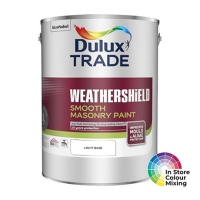 Dulux Trade Weathershield Smooth Masonry Paint Custom Colour 5LFrom £0.00 £42.99 From
Choosing Masonry Paint for Render, Brick & Concrete
Choosing the right masonry paint starts with the wall itself. Render, brick, masonry, stone and suitable concrete can all behave differently, so surface condition and exposure should be considered before colour or finish. The range includes smooth masonry paint and silicone masonry paint, giving you different options for exterior decoration and protection.
For paint for concrete, make sure the individual coating is suitable for the specific concrete surface being painted. The same principle applies across masonry backgrounds: the product needs to match the substrate and its condition rather than being chosen on colour alone. The category also includes K Rend masonry paint for compatible rendered and masonry surfaces alongside smooth exterior coatings for broader exterior projects.
Smooth vs Silicone Masonry Paint: Which System Suits the Wall?
Smooth and silicone systems provide different performance characteristics, so the right choice depends on the wall and what is required from the coating. A water-based smooth masonry paint in the range provides coverage of up to 16m² per litre on smooth, low-porosity render, becomes shower resistant in approximately 30 minutes and can be recoated after 2–4 hours.
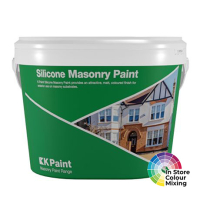
K Rend silicone paint combines high water-vapour permeability with low liquid-water absorption. In practical terms, this allows moisture vapour to pass through the coating while helping limit rainwater absorption from the outside. An 18kg container covers approximately 45–65m² over two coats on a smooth surface.
The choice should therefore be based on the wall system and required performance rather than coverage alone. For K Rend projects where colour selection is important, explore the K Rend Colour Mixing Lab for ready-mixed and custom-colour options.
Fresh Render, Weathered Walls or Bare Concrete: Start with the Surface You Have
A newly finished wall, an older weathered elevation and bare concrete should not automatically be treated in the same way. New masonry needs to be fully cured and dry before painting, while existing surfaces must be sound and free from loose material, dust, grease, algae, lichen and other contamination.
The first-coat method also changes according to the product and condition of the wall. K Rend silicone masonry paint uses a first coat diluted by up to 10% with clean water, followed by an undiluted second coat. Smooth masonry systems can require a thinned sealing coat on sound new or bare surfaces, while persistently powdery or chalky backgrounds may need a suitable stabilising primer.
If the wider project also includes new masonry construction, compare suitable Facing Bricks and Concrete Blocks alongside the finishing system.
Why Surface Texture Can Change How Much Masonry Paint You Need
Coverage figures should never be considered without looking at the wall texture. A rough or heavily textured surface can use substantially more exterior masonry paint than a smooth wall of exactly the same size.
For K Rend silicone masonry paint, an 18kg container covers approximately 45–65m² over two coats on smooth surfaces. On textured surfaces, this falls to around 30–36m², with very rough backgrounds reducing coverage further.
The same principle applies to smooth masonry coatings. A product providing up to 16m²/L on smooth, low-porosity render can fall to around 4–6m²/L on textured surfaces such as pebble-dash.
This is why measuring the wall area is only the starting point. Texture and porosity also affect how much paint the project is likely to require.
Painting in Changeable Weather: Temperature, Rain & Recoat Times
Weather conditions are part of the specification when applying exterior wall paint. K Rend silicone masonry paint should be applied between 5°C and 30°C, with approximately 8–12 hours between coats.
The smooth masonry option has different limits: it should not be applied below 7°C, during rain or fog, or when relative humidity is above 80%. Under suitable conditions, it can normally be recoated after 2–4 hours and is shower resistant in approximately 30 minutes. A dry start to the day does not automatically make it suitable for exterior painting. Temperature, rain risk, humidity and the time needed before the next coat should all be considered before starting a large elevation.
Both systems can be roller applied, so suitable Paint Rollers can be selected according to the coating and surface texture.
When choosing masonry paint colours, full elevations should also be planned carefully. For K Rend Silicone Masonry Paint, the same batch should be used across full elevations and adjoining panels to help maintain consistent colour across the finished surface.
Choosing White Masonry Paint & Exterior Colours That Suit the Property
The colour of an exterior wall affects how the whole property looks, so it is worth considering more than the wall on its own. White masonry paint gives exterior walls a clean, bright appearance and can create a strong contrast against darker roof tiles, windows, doors, guttering or brick details. If several of those features are already light, one of the other masonry paint colours may give the building more definition and help the different elements stand apart.
When choosing exterior masonry paint, look at the parts of the property that are staying as they are. Existing brickwork, stone, roof colours, window frames, fascias and nearby paving can all influence whether a bright white, warmer neutral or deeper shade feels right. When choosing masonry paint white, remember that a lighter finish can make an exterior look noticeably fresher, although dirt and weather marks may also be easier to see than on some mid-tone colours.
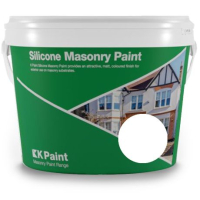
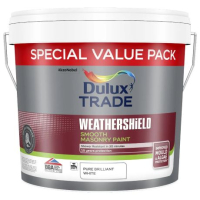
If a crisp white finish suits the property, dulux weathershield masonry paint white provides a Pure Brilliant White option, while k rend silicone masonry paint white 18kg provides a Bright White option within the K Rend range. Both give you a clear white finish, so once you have settled on the colour, the final choice can be based on the surface you are painting and the type of masonry coating the job requires.
FAQs
Can you use masonry paint on wood?
Not as a general rule. Masonry paint is designed for mineral surfaces, so timber should be coated with a product specifically approved for wood. If wood is not listed as a suitable substrate for the paint, use a dedicated wood coating instead.
Can you use masonry paint indoors?
Do not assume an exterior masonry paint is suitable for internal use. The masonry paints in this category are exterior coatings, so interior masonry should be finished with a product specifically approved for indoor use and for the substrate being painted.
How do you remove masonry paint from brick?
Loose or failing masonry paint can be carefully scraped back to a firm edge. Where complete removal is required, a suitable chemical paint remover can be used, provided it is compatible with the brickwork. Work on a small test area first and avoid aggressive removal methods that could damage the brick face or mortar joints.
Can you spray masonry paint?
Yes, selected masonry paints in this category can be spray applied. K Rend Silicone Masonry Paint can be applied by brush, roller or spray, while Dulux Trade Weathershield Smooth Masonry Paint can be applied by brush, roller or airless spray. Use the application method, thinning requirements and equipment settings specified for the individual product.
Can you use masonry paint on metal?
Masonry paint should not be treated as a general-purpose metal coating. Unless the individual product specifically lists the metal substrate as suitable, use a dedicated metal paint system designed for that surface.
Can you use masonry paint on plastic?
Masonry paint is not normally intended for plastic. Plastic surfaces require a coating specifically designed to adhere to the particular type of plastic, so masonry paint should only be used if that substrate is explicitly listed as suitable.
How do you clean masonry paint off brushes?
Remove as much excess paint as possible immediately after use. For water-based smooth masonry paint, wash brushes and rollers promptly in warm soapy water, rinse thoroughly and allow them to dry naturally. Collect the wash water rather than flushing paint residue into drains.