

Filters
Shopping Options
Applicator Guns
Shop applicator guns at MGN Builders Merchants for sealing joints, filling gaps and pointing brickwork. Choose from cartridge guns for sealants and caulk, alongside bulk-fill mortar guns. Check the gun’s capacity, filling method and suitability for the material you’re applying to find the right option for your job.

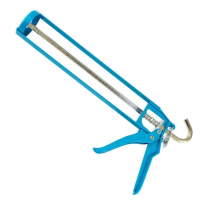
Applicator Guns for Sealing, Bonding and Pointing
Sealing around skirting, bonding trim and repointing brickwork call for different applicator guns. The material and its packaging determine which one you need.
A sealant gun, also commonly called a mastic gun, pushes material from a cartridge. A bulk-fill mortar gun is loaded with mixed mortar directly into its barrel. These loading methods need different tools.
For cartridge work, choose adhesives and sealants that suit the surfaces and conditions involved. Then check which gun fits the pack and can dispense the material.
Choosing a Caulking Gun That Fits the Cartridge
A caulking gun needs to hold the cartridge securely, with its plunger lined up against the base. Check the compatible cartridge sizes before buying, particularly if you use several products with different pack sizes.
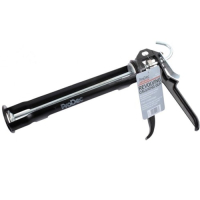
For example, the ProDec Advance revolving caulking gun accepts both 310ml and 400ml cartridges. Larger cartridges need an applicator specifically sized to accommodate them.
Beyond capacity, think about how you’ll use the gun:
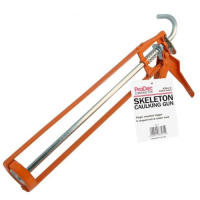
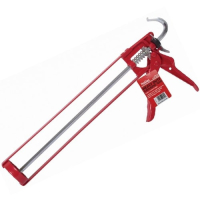
- Frame: an open skeleton frame leaves the cartridge visible, while reinforced designs provide additional support.
- Access: allow room for the handle and nozzle, especially behind fittings or close to corners.
- Grip and weight: choose something you can hold comfortably through the length of the joint.
Getting an Even Bead
When using a silicone gun, steady trigger pressure, a suitable nozzle opening and consistent movement help you apply an even bead. Try a short run on scrap material before starting a visible joint so you can get a feel for the flow.
Thicker materials take more force to dispense. A heavy-duty sealant gun designed for higher-viscosity products can help, but it still needs to be compatible with the material you’re applying. A revolving holder is useful when you need to change the nozzle’s orientation around a corner without turning the whole gun.
Use the pressure-release mechanism when stopping to relieve pressure on the cartridge. Keep the nozzle clear, and follow the sealant’s instructions for preparing the surface, smoothing the bead and allowing it to cure.
Mortar Guns for Masonry and Paving Joints
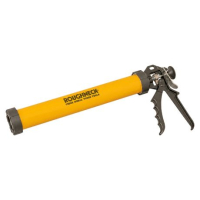
A mortar pointing gun feeds mixed mortar into prepared joints. The Roughneck Trade Mortar Gun 750ml is designed for bulk mortar and includes straight and angled nozzles for reaching different parts of the work.
Before loading the gun, consider:
- The joint: choose a nozzle that lets you place mortar where it’s needed.
- The mix: follow the mortar and gun instructions for a consistency that will pass through the nozzle.
- The finish: allow time to work the mortar to the required profile after placing it.
Keep suitable pointing trowels and brick jointers alongside the gun for working and finishing the joints. Clean reusable barrels, plungers and nozzles promptly after use, using the manufacturer’s recommended method before the mortar hardens.
FAQs
Is a mastic gun the same as a caulking gun or silicone gun?
Yes, these names commonly refer to the same type of cartridge applicator, also called a sealant gun. Models differ in cartridge compatibility, frame strength and the force they can apply to dispense thicker products. A bulk-fill mortar gun is loaded with mixed mortar directly into its barrel rather than a sealed cartridge.
How do you load a sealant gun?
Open the cartridge seal as directed on the packaging, screw on the nozzle and trim its tip at an angle, starting with a small opening. For a typical manual gun, press the release lever and pull the plunger rod fully back, then fit the cartridge into the holder according to the gun’s instructions. Bring the plunger into contact with the cartridge base and gently squeeze the trigger until material reaches the nozzle tip.
How do you stop a sealant gun dripping?
On a typical manual gun, use the pressure-release lever when you stop and retract the rod slightly if needed to relieve pressure on the cartridge. The Bond It Jumbo Sealant Gun 900ml has an anti-drip release mechanism to help control residual flow, but this should not be treated as a guarantee of automatic pressure release. After use, cap or seal the nozzle as directed by the sealant manufacturer to help limit curing in the tip.
Should I choose a skeleton or heavy-duty caulking gun?
A basic skeleton gun is often sufficient for occasional jobs with standard sealants and decorators’ caulk. For stiffer adhesives or frequent use, look for a reinforced gun with a dispensing force suited to the material, rather than choosing by frame style alone. A revolving cartridge holder is useful around corners, frames and fittings because it lets you adjust the nozzle’s orientation without turning the whole gun.
How do you repoint brickwork with a mortar gun?
Choose a mortar suitable for the existing brickwork and the gun, then rake out defective joints to the required depth, remove dust and dampen the joints as appropriate. Prepare the mix according to the mortar and gun instructions, then feed it into the back of each joint and compact it with a suitable pointing tool, working in layers where needed. Once the mortar has firmed sufficiently, finish the joints to the specified profile and protect the fresh pointing during curing.